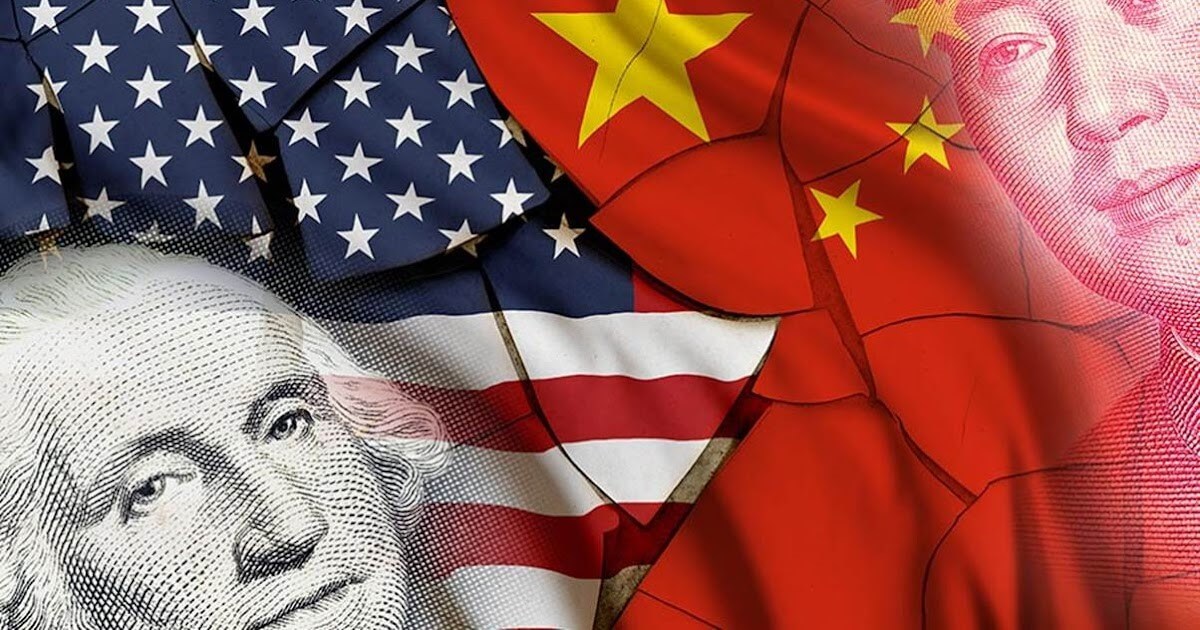
There is a striking contradiction at the heart of global affairs today. The two largest economies in the world, the United States and China, generate nearly 43 percent of global GDP between them, lead the world in scientific publications, and together account for the overwhelming majority of AI patents and investment. Yet they appear increasingly determined to build parallel technological universes, each walled off from the other. As 2026 opens, the cost of this trajectory is becoming impossible to ignore.
Two-way merchandise trade between the two countries reached $688.3 billion in 2024, 275 times the volume recorded in 1979 when formal diplomatic ties were restored. That figure represents supply chains, livelihoods, and decades of interdependence woven so deeply into both economies that complete decoupling, as leading economists have concluded, is simply not feasible. Yet the first eleven months of 2025 saw U.S. exports to China fall 13.2 percent year-on-year, and 20.9 percent below levels of three years ago. That is not competition. That is contraction, and both sides are paying for it.
The tariff measures that drove much of that decline pushed the average U.S. worldwide tariff rate to 17.3 percent in 2025 — its highest level since 1935. According to U.S. government estimates, 64 percent of that tariff burden fell on American businesses and 22 percent on American consumers. High tariffs did not bring manufacturing back to the United States. They raised prices, squeezed corporate margins, and reduced consumer confidence. Meanwhile, China's export engine adapted and kept moving: China's total exports reached a record $970.6 billion in the third quarter of 2025 alone, a 6.6 percent year-on-year increase, as Chinese firms redirected trade flows and deepened ties with the Global South.
The stakes are highest in technology, where the logic for cooperation is most compelling, and the consequences of failure most severe. Artificial intelligence alone is projected to contribute $15 trillion to the global economy by 2030, according to the Semiconductor Industry Association. China and the United States are, without question, the two leading AI powers on earth. China's DeepSeek model, launched in January 2025, demonstrated that Chinese research institutions are capable of producing frontier-class AI at dramatically lower cost and higher energy efficiency, a development that reframed assumptions about who sets the pace of global AI development. The implication is opportunity. Two research powerhouses working across common problems — climate modeling, drug discovery, materials science, agricultural productivity — can achieve what neither can alone.
If the two countries allow their technological ecosystems to diverge completely, the global digital economy will fracture along with them. The World Economic Forum warned in mid-2025 that the world stands at a crossroads: one path leads to a digital iron curtain separating U.S.-led and China-led technology spheres, with incompatible standards, isolated supply chains, and rival AI ecosystems. The other path, more difficult, but far more rewarding, involves structured dialogue that prevents the worst outcomes while allowing both sides to protect what is genuinely sensitive.
There are signs that pragmatism has not entirely given way to ideology. At the APEC summit in South Korea in October 2025, President Donald Trump and President Xi Jinping met face-to-face for the first time since Trump returned to office, agreeing to a temporary trade truce that included lower tariff rates and a suspension of Chinese export controls on rare earths. That meeting demonstrated that when the political will exists, structured progress is achievable. U.S. Treasury Secretary Scott Bessent simultaneously announced that U.S. and Chinese trade negotiators had reached a substantial framework at the ASEAN meeting in Kuala Lumpur. These are foundations that can be built upon.
In August 2025, U.S. chip giant Nvidia confirmed the U.S. government would allow the sale of certain AI processors in China, reversing an export ban imposed only months earlier. Stanford University's Professor Srabanti Chowdhury captured the right lesson from that pivot: resilience in the semiconductor industry, built to be interdependent, should be achieved through healthy competition and collaboration and not through isolation. The semiconductor ecosystem took decades of shared investment and cross-border knowledge transfer to build. Dismantling it would cost far more than any tariff revenue could ever recover.
Perhaps nowhere is the case for engagement more urgent than in AI governance. The development of large-scale AI systems carries risks that respect no national boundary: algorithmic bias embedded in global platforms, autonomous systems making consequential decisions without adequate oversight, and the accelerating use of AI in military contexts that existing international law was never designed to address. Washington and Beijing are the only two actors with the scale, talent base, and institutional capacity to set binding global norms in this space. If they cannot agree on even a baseline framework for AI safety, the rest of the world will be governed by accident rather than design.
China's 15th Five-Year Plan, currently in preparation and expected to guide national priorities through 2030, identifies artificial intelligence, semiconductors, biomanufacturing, and quantum computing as foundational strategic priorities. The United States is making comparable investments across the same domains. The parallel is not a coincidence. It reflects where the global economy is heading. The question is whether both governments choose to treat that convergence as a source of conflict, or as the foundation for a structured, decades-long cooperation framework that could accelerate economic growth in both countries and set responsible standards for the world.
Technology and innovation do not recognize borders. The scientific breakthroughs of the coming decade, in clean energy, medicine, food security, and climate adaptation, will not be made by either country acting alone. The path that serves both peoples, and indeed the world, is one of calibrated engagement: protecting what is genuinely sensitive while staying open to the collaboration that drives long-term progress.
Muhammad Asif Noor,
Founder, Friends of BRI Forum and Advisor to Pakistan Research Centre,